I’ve thought for some time about how human behavior when interacting with technology has evolved, even in my short lifetime that I can observe. Walking and driving down streets you see individuals nearly hypnotized by their smartphones, whether sauntering like zombies down the walkway or needing to read the screen of the phone while driving. I’ve often wondered whether the quality of my life has been improved by the newfound connectedness mobile technology provides. Reflecting on my high school days when none of my friends had mobile phones or even pagers, we somehow endured and enjoyed life all the same. Change is the only constant…yet that doesn’t mean with change comes improvement.
Have people radically evolved in such a short time? I’m not so sure…and therein lies my hypothesis on why human interaction with smartphones appears to be making people, quite interestingly, less smart.
Moore’s Law tells us that computing power, on average, doubles every 18-24 months which means the power grows at a geometric rate over time. This would be extremely beneficial if a human’s ability to adapt and interact with smartphones also grew geometrically. However, I might theorize (I confess I am no expert in human cognition) that a human’s ability to adapt grows at more of a linear rate over time. The below graphic can help illustrate this.
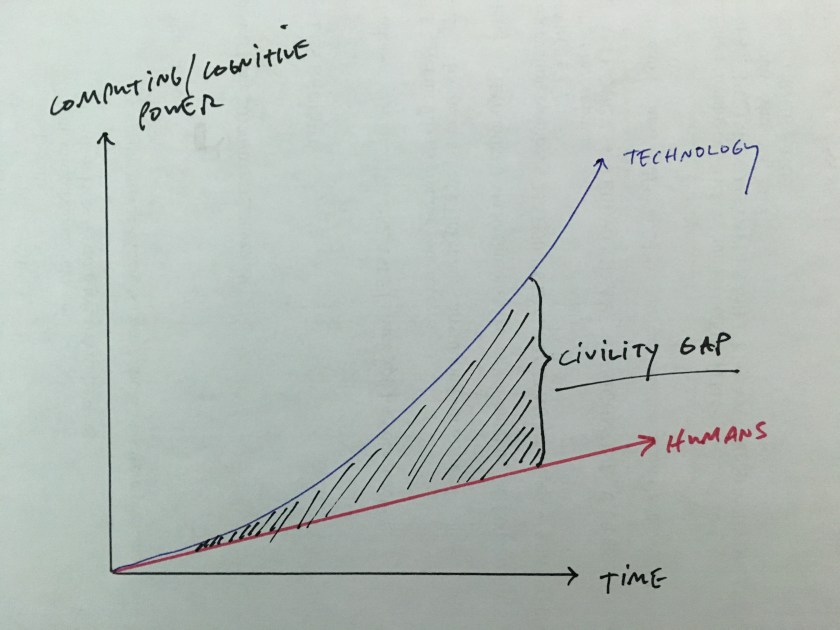
The graphic shows that as time increases (moving right in the picture), the gap between the two lines representing human’s ability to interact intelligently with technology and computing power vastly increases over time. I call this theoretical difference the ‘Civility Gap’. This implies that as time moves forward we will not only see humans continue to struggle with using new technology like smartphones, but that struggle will significantly increase over time because the gap between the two lines will continue to grow.
Of course, the short sample I’m using here through my own frame of reference is likely too small to extract any real conclusions or project them forward, but I do see a change in our ability to intelligently interact with technology. It’s as if people are completely overwhelmed and don’t know what to do, yet they do believe they are acting smartly…
My curiosity grows when thinking 100 years from now, will we see a world where the civility gap has slowed, or will we reach a tipping point, some new technology that not only increases computing power, but improves the way in which humans can intelligently interact with everyday technology? One can only hope!
 houckOUT