The Future Viability of Posts and a Most Critical Postal Conference (Part 2)

It took me much deliberation and more research… But I was finally able to focus my thinking around what I wanted to do with this year’s paper for the Postal and Delivery Economics conference in Barcelona. As I mentioned in an earlier post, this was not easy. My research topic was broad, which caused significant issue deciding on common themes. But thanks to much discussion with colleagues, things became more cohesive as I began writing.

We all know mail volumes have fallen…some would say even crashed. Yet I would say volumes are not the most critical element that will define the future financial viability for posts in the future. Demographics, re-urbanization, and new entry in the last mile will trump volume fluctuation in the years ahead. The most critical element will be brand.

Posts have enjoyed a monopoly on brand and trust in parcel delivery over the last 30 years and have earned that trust over time. This is equally true for other established delivery providers such as UPS and FedEx. What I find most interesting is how new entrants to parcel delivery, like Uber and Lyft, can build trust in such a short time frame. This allows them to compete in these market spaces. This trust, which used to take decades to obtain, can almost be earned with a single few deliveries of outstanding quality and price, just like an everyday Uber ride.

This creates the biggest single threat for posts. If trust can be earned this quickly, and the price and quality of delivery is commensurate for entrants, parcel volumes, especially products such as Parcel Select in the U.S., are at risk of diversion away from posts. One can quickly imagine a reverse auction paradigm, a la the eLance / Upwork model. Fueled by online platforms that allow any agent to bid on a given delivery, the highest quality delivery service could well be the cheapest.

I’m struck by the resulting implications from this effect. There’s much last mile business at risk in the years ahead. Posts must decide whether to offer new value added services to customers or engage in a race to the bottom. The latter will mean driving price to marginal cost, commoditizing delivery and compete solely on price. With the paper due May 7 and the conference beginning May 24, time is drawing closer.

Stay tuned to see how the paper is received at the conference and how the presentation / defense goes on 5/27! #IBMAoT

The Civility Gap (Part 1)

I’ve thought for some time about how human behavior when interacting with technology has evolved, even in my short lifetime that I can observe. Walking and driving down streets you see individuals nearly hypnotized by their smartphones, whether sauntering like zombies down the walkway or needing to read the screen of the phone while driving. I’ve often wondered whether the quality of my life has been improved by the newfound connectedness mobile technology provides. Reflecting on my high school days when none of my friends had mobile phones or even pagers, we somehow endured and enjoyed life all the same. Change is the only constant…yet that doesn’t mean with change comes improvement.

Have people radically evolved in such a short time? I’m not so sure…and therein lies my hypothesis on why human interaction with smartphones appears to be making people, quite interestingly, less smart.

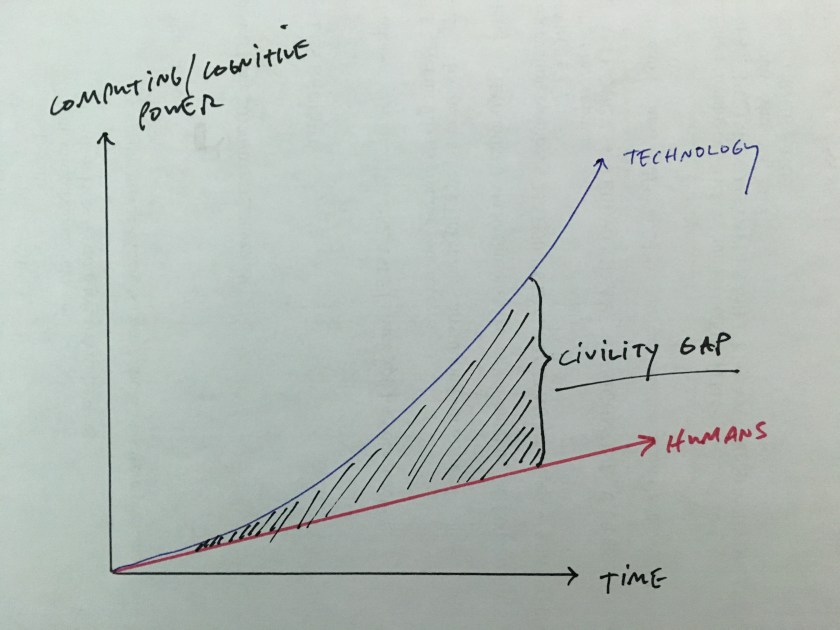
Moore’s Law tells us that computing power, on average, doubles every 18-24 months which means the power grows at a geometric rate over time. This would be extremely beneficial if a human’s ability to adapt and interact with smartphones also grew geometrically. However, I might theorize (I confess I am no expert in human cognition) that a human’s ability to adapt grows at more of a linear rate over time. The below graphic can help illustrate this.

Civility Gap

The graphic shows that as time increases (moving right in the picture), the gap between the two lines representing human’s ability to interact intelligently with technology and computing power vastly increases over time. I call this theoretical difference the ‘Civility Gap’. This implies that as time moves forward we will not only see humans continue to struggle with using new technology like smartphones, but that struggle will significantly increase over time because the gap between the two lines will continue to grow.

Of course, the short sample I’m using here through my own frame of reference is likely too small to extract any real conclusions or project them forward, but I do see a change in our ability to intelligently interact with technology. It’s as if people are completely overwhelmed and don’t know what to do, yet they do believe they are acting smartly…

My curiosity grows when thinking 100 years from now, will we see a world where the civility gap has slowed, or will we reach a tipping point, some new technology that not only increases computing power, but improves the way in which humans can intelligently interact with everyday technology? One can only hope!

The Future Viability of Posts and a Most Critical Postal Conference (Part 1)

This year’s Postal and Delivery Economics conference in Barcelona will be different. The founder, Michael Crew, passed away late last year and during his 25+ years at the helm with the late Paul Kleindorfer. The conference grew to amass the keenest minds in the postal world in wonderful locations around Europe (predominantly) annually to further the research on topics that affect every citizen of the world.

I’ve contributed to every conference in the last 10 years, where it has taken me on quite the professional and personal journey, developing and sharpening my intellectual scalpel, and filling my passport with immigration stamps from fascinating locations like Jersey, Bordeaux, Athens, and Rome. But this year is different. It’s been more difficult to focus my mind and put pen to paper, even though much of the research for my paper was finished weeks ago. I wonder…is there a subconscious hesitation, a realization this year marks the start of something entirely new for the conference? Indeed, change is often not easy.

Like any other year, after much reading and talking with colleagues and friends, I zeroed in on my topic for this year’s paper in November 2016 and submitted the abstract to the governing board for approval. While it is important to continue evaluating the impacts of declining mail volumes on the viability of the postal sector, it is equally important to examine the resulting effects of additional forces and their implications. Nascent last mile collaborative logistics arrangements, evolving customer expectations, changing demographics, entry for parcel delivery in the last mile by firms such as Uber, innovations in key technologies such as the Internet of Things (IoT), and other exogenous factors are causing tectonic shifts in traditional delivery models and challenging the viability of century-long roles of POs.

Research I performed with the USPS OIG last year on the Emerging Logistics Landscape and a recent McKinsey piece on focused my mind on this year’s topic, which has taken me down some deep rabbit holes and spun me in circles for days, trying to box in what is an otherwise massive topic. A dear colleague and friend who has also attended countless postal conferences offered to read my abstract and expressed one clear message: ‘Be careful…you understand how much you’re biting off here?’

With the paper due on April 25 and the conference beginning May 24, time is drawing closer. Stay posted to see when inspiration strikes in this very different year! #IBMAoT

“No, I never thought about that…”

Standing outside the polling station on Election Day I got into a chat with a VCU political science major about executive power, and how expanding the power of the President isn’t necessarily a bad thing. Given he was handing out sample Democratic ballots I broached the idea of gay marriage…

He explained to me it is unequivocally a good thing that the government, most notably the President, seized the power to define what marriage is…he very much thanked Obama for seeking to expand that definition that could now include same-sex couples. I cautioned that is great when you agree with the definition…but as Presidents are only in office of at most 8 years, what if the next President exercises that same power and changes the definition? He looked like a deer in headlights…who had just soiled his pants.

“No, I never thought about that…”

We are now in a post-Obama, now-Trump world and much of what we are seeing is the direct result of relinquishing too much power to the Executive Branch and people, most notably Democrats, are up in arms. They fail to realize these same powers resided in President Obama yet because they agreed with his positions and actions, they were happy clams. It is a lot like your parents growing up…we are OK with their rules as long as we agree with them. When we no longer agree, buckle up for the bumpy ride ahead….and the occasional (OK, perhaps more frequent) crying fits.

Trump is only marginally to blame. The real issue is the expanded power of the Executive, the imbalance of power among the 3 branches of government, and where we find ourselves today.

Should we stop Trump? Yes. However, what we should seek to remedy is to remove the power from the Executive, not just Trump….and sadly I fear most neither see the link between the two, nor understand the implications.

Indeed, the system IS rigged, but not for the reasons most understand

Gary Johnson never had a chance in making the stage for the Presidential debates in 2016.

The reasons can clearly be traced to media strategy, laziness by the populous, and something known as character theory. Indeed, the media has helped to make the U.S. population intellectually lazy; and we have allowed them to do it. One must realize and acknowledge that a newspaper or other media outlet’s objectives is not to educate a population in an election in order to help the citizenry make the most informed choice; the media’s goal is to attract eyes in order to sell advertising and earn money.

At a conference six years ago I was struck by a phrase from Vint Cerf, Presidential Medal of Freedom recipient, ‘Father of the Internet’, and currently the Chief Internet Evangelist for Google. He said Google’s business model was to sell advertising. Reflect on that for a moment, then consider its implications for the media culture in which we live. Nearly every moment of every day is a competition for eyeballs, and the winner is rewarded by larger advertising dollars designed to reach more American consumers. The context of elections is no different. CNN, MSNBC, Fox News, the BBC, USA Today, the New York Times, all desire one thing: ratings.

Mainstream media outlets have no vested interest in erecting a third podium on the debate stage for one simple reason: it would detract from the prototypical antagonist-protagonist form of debates, literature, and film. Without question, a third party complicates things. They reduce the total airtime devoted to pitting Trump against Clinton; they force moderators and citizens to consider a third (perhaps non-traditional) viewpoint on a given issue; and perhaps most importantly in the media cycle today, they can detract from the convenient narrative that the debate is a winner take all title bout in which either the Democrats or Republicans will emerge victorious.

Character theory is used to analyze literature, plays, films, and media. Broadly, there are several character types of which many are familiar: the hero, the villain, the false hero, among others. Applying this theory to the upcoming Presidential debates, I would hypothesize that media outlets realize the best opportunity to drive ratings is to exclude any outside forces that could potentially detract from the singular Clinton – Trump showdown.

Just whisper the word ‘conspiracy’ and one immediately risks marginalizing his position and subjecting himself to laser-focused criticism, typically of the superfluous form. However, if one decomposes ‘conspiracy’ to its basal elements (its definition according to Merriam Webster) we find that a conspiracy is ‘a secret plan by a group to do something unlawful or harmful.’ While I will concede the media portrayal of the Johnson campaign might not be orchestrated by a cartel of media moguls smoking cigars in dimly-lit rooms, one cannot ignore the actions of the media stemming from recent events, including ‘Aleppo-gate’, and chalk it up to journalistic independence. Indeed, signs point to a systemic plan to immediately discredit the Johnson campaign because of this one gaffe, even though the same media outlets mostly failed to respectfully cover his campaign at any point in the recent past.

Recalling that the media’s objective to attract eyes, readership, and circulation to sell advertising, it is not surprising to consider that educating the populous on ALL available candidates for President is not a primary goal. Rather, creating, then promoting the simplistic ‘hero versus villain’ narrative is the best option to drive readership and viewership through to Election Day. Consider Walter Shapiro’s recent Op Ed piece on September 16: “Hillary Clinton, for all her flaws and failings, is the only person standing between Trump and the Oval Office. Cluttering up the debate stage with a third candidate — whose presence will inevitably change the tenor of the evening — is far too risky. It’s dangerous enough that America is currently chancing handing the nuclear codes to a bilious billionaire.”[1]


Unfortunately, this does a considerable disservice to the citizenry. Not only has this media paradigm succeeded in promulgating the false narrative that voting for a third party candidate is wasting one’s vote, it has also limited the amount of media coverage devoted to Johnson and Stein, which results in artificially low polling numbers for these candidates. Again, in isolation it is easy to dismiss low polling numbers as confirmation of the lacking viability of a Johnson candidacy however the consequences are much more damning and far reaching. The low polling numbers are a direct result of the populous not knowing who Johnson is, in large part due to the media’s own refusal to provide respectable coverage of his candidacy; in essence the media is controlling the outcome of the game itself.

The end result is Johnson failed to reach the arbitrary 15% polling threshold established by the Commission on Presidential Debates and will not share the stage with Trump and Clinton on September 26 in the first debate. Never mind that Johnson is polling higher than Ross Perot at the same point in the election of 1992, or that 62% of Americans polled want Johnson in the debates.[2]

Sadly, Johnson never stood a chance of making the debate stage and there is little he, you, or I could have done about it. It is not convenient. It is not to the benefit of those in media looking to drive ratings. It would complicate the job of columnists and news outlets who will write and cover the aftermath of the first debate. Unfortunately for every American, it continues to perpetuate the myth that the only choice we face in every election is whether to pull the voting lever for Red or Blue.

[1] http://www.rollcall.com/news/opinion/presidential-debates-gary-johnson-donald-trump-hillary-clinton-risk

[2] https://www.qu.edu/news-and-events/quinnipiac-university-poll/national/release-detail?ReleaseID=2375